




MUSCAT, OCT 12
Nama Power and Water Procurement (PWP) has sold more than 600,000 International Renewable Energy Certificates to buyers in Oman and is offering around 3 million to the market, as businesses seek verifiable renewable electricity claims for sustainability reporting and export customers.
The market’s next phase will require wider awareness, simpler access and additional trading channels, Eng Dawoud Sulaiman al Balushi, Project & Contracts Chief Engineer of Nama PWP, told the IEEE Powertalks in Oman.
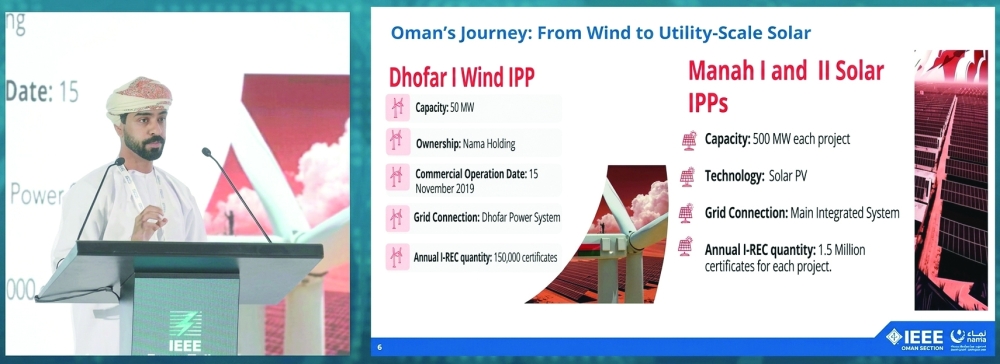
Certificates available through Nama PWP draw on the Dhofar 1 wind project and the Manah 1 and Manah 2 solar plants, expanding the renewable generation portfolio underpinning the market since its launch in 2023.
“We need to simplify the market access and to remove any barriers to those customers,” Al Balushi said.
Each I-REC represents the renewable energy attributes of one megawatt-hour of electricity generated. It allows a buyer to match electricity consumption with verified renewable generation, even when power is delivered through a grid supplied by both renewable and conventional plants.
The mechanism addresses a challenge for companies seeking to demonstrate renewable electricity use: electricity from solar, wind and gas-fired plants mixes in the network, making it impossible to trace individual electrons to a particular consumer.
Through a book-and-claim system, the renewable attributes are recorded separately from physical electricity delivery, transferred to buyers and redeemed against specified consumption.
Al Balushi stressed that an I-REC “is not a carbon credit”.
The certificates support market-based reporting of Scope 2 emissions associated with purchased electricity. They do not directly address emissions from a company’s own operations under Scope 1, or those across its wider value chain under Scope 3.
Nama PWP’s registered portfolio includes the 50-megawatt Dhofar 1 wind plant, which can provide about 150,000 certificates annually, according to the presentation.
The two Manah solar plants, each with a capacity of 500 megawatts, can each provide around 1.5 million certificates a year. Those figures represent potential annual certificate volumes, separate from the roughly 3 million Al Balushi said were being offered to the market.
Oman registered its first wind project for I-RECs in 2023 and announced its first wind certificate auction that year, he said.
Nama PWP currently sells certificates through auctions and direct agreements. Direct sales allow customers to agree quantities and prices over one year or longer periods, while auctions involve published instructions, bidder clarifications, evaluation and contracts with successful buyers.
Following payment, certificates are transferred to customer accounts. Redemption statements identify the beneficiary, generation source, quantity, reporting period and purpose, preventing the same renewable attributes from being claimed by another consumer.
Al Balushi cited applications across manufacturing, technology and emerging clean-energy businesses, without naming the buyers.
A cable manufacturer used certificates against 9 per cent of its Scope 2 emissions, a carbon removal company against 100 per cent, and a telecommunications and technology provider against 25 per cent, he said.
Oman’s first green hydrogen mobility station also purchased certificates to support renewable electricity claims for its grid consumption. An iron casting manufacturer used them to demonstrate renewable electricity sourcing to customers in Europe and America.
Despite growing participation, limited understanding of the certificates and their applications remains an obstacle, Al Balushi said.
He called for live markets and trading platforms alongside existing sales channels, coupled with clearer rules.
“I think it is very important as well to have a clear framework regulating the I-REC sector here in Oman,” he said.
Nama PWP should also assess whether carbon-credit mechanisms could operate alongside I-RECs as its renewable project portfolio expands, he added, presenting this as an area for further assessment rather than an established arrangement.
Oman Observer is now on the WhatsApp channel. Click here